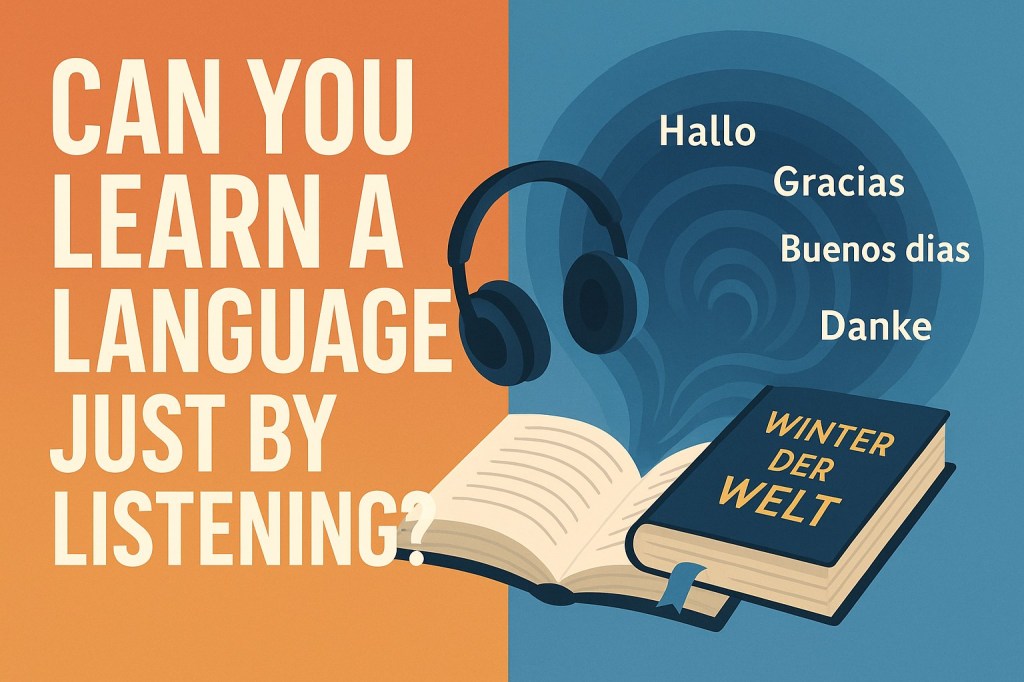
Can you really learn a language just by listening to audiobooks? That’s a question I wanted to put to the test.
if you want to see my full breakdown, check out the video version of this experiment here:
As a language learner, I’ve experimented with a lot of methods: apps, flashcards, speaking practice, even immersion abroad. But one method intrigued me — listening to books in my target language that I had already read in English. Would the familiarity of the story give me enough context to follow along and actually learn?
To test this, I chose one of my favorite novels: Fall of Giants by Ken Follett. Instead of rereading it in English, I downloaded the German audiobook version, Sturz der Titanen, narrated by Philipp Schepmann. At thirty-seven hours long, it was a serious time investment — but the results surprised me.
Why Audiobooks for Language Learning?
Audiobooks give you something that’s hard to find elsewhere: extended listening exposure in a natural, authentic voice. Unlike classroom dialogues or short YouTube clips, audiobooks sustain you in a language for hours at a time. You hear the cadence, rhythm, and vocabulary in context, often with professional narration that makes the language come alive.
Linguists often talk about comprehensible input, an idea embraced by polyglots like Steve Kaufmann. The idea is that learners grow best when they consume language that is just above their current level. You don’t need to understand every word — you just need enough context to keep going.
As Kaufmann puts it: “You need to get used to the language — the sounds, the rhythm, the intonation. Even if you don’t understand, your brain is getting used to the language.”
The LingQ blog echoes this: “Listening without understanding every word still helps you improve comprehension over time, because you’re training your brain to recognize patterns.”
The Experiment Setup
Here’s how I structured my test:
- Book: Fall of Giants by Ken Follett
- Audiobook: Sturz der Titanen (German edition), narrated by Philipp Schepmann
- Length: 37 hours (Audible)
- Plan: Listen daily while commuting, exercising, or winding down in the evening.
My goals weren’t to translate line-by-line. Instead, I wanted to:
- Improve comprehension
- Pick up vocabulary in context
- Internalize prosody (the rhythm, stress, and intonation of German speech)
What Linguists Say About Listening
Research suggests that around 30–35 hours of listening can lead to noticeable comprehension gains. It’s not about memorization — it’s about exposing your brain to thousands of phrases until recognition becomes automatic.
This is why long audiobooks are such powerful tools: they give you concentrated hours of exposure without needing to constantly reset or restart. Instead of drilling words in isolation, you’re absorbing them in a meaningful story.
My Personal Results
German Progress
At first, listening to Sturz der Titanen felt overwhelming. Schepmann’s voice was fast and fluid, and I could barely hold onto a single sentence. But after about ten hours, something shifted. I started recognizing repeated words and phrases. By the twenty-hour mark, I was following the outline of scenes, even if I didn’t catch every detail.
The biggest gain was in prosody. I began to feel the natural rhythm of German — the rise and fall of sentences, how words connected, the pacing of conversations. Instead of translating, I was just hearing.
Sentence Structure Breakthrough
One major breakthrough came with German subordinate clauses. In these structures, triggered by words like weil (because) or dass (that), the verb gets “kicked” to the end of the sentence.
Example: Ich lerne Deutsch, weil ich in Deutschland leben möchte.
(“I’m learning German because I want to live in Germany.”)
I’d studied this rule before, but it never stuck. Hearing it hundreds of times in the audiobook made it feel natural. I wasn’t thinking about grammar rules anymore — I was just recognizing the pattern. While this is a small victory, it has opened the door to understanding that much more of the material I come across.
Why German Worked Better
This method worked better in German than it has so far in Spanish. The reason is simple: I already had a higher comprehension level in German. That meant I could stay engaged longer, focus more, and extract meaning even when I didn’t know every word.
Because of that, I felt like I was genuinely getting more out of each listening session.
Spanish Challenge
When I tried the same audiobook method in Spanish, the experience was different. My Spanish is still at a lower level, so long listening sessions quickly became tiring.
I could often distinguish the starts and stops of words, and sometimes even guess how they might be spelled. But without enough vocabulary, I couldn’t catch the context. That made it difficult to stay motivated.
Adjusting the Approach
For Spanish, I’ve shifted gears. Instead of pushing through thirty-seven hours of audiobook, I’m taking a step-by-step approach:
- Working through Madrigal’s Magic Key to Spanish (one chapter a day)
- Adding short podcasts
- Reading on LingQ for structured input
This combination gives me the foundation I need so that audiobooks can become useful later, when my comprehension is stronger.
The Ongoing Experiment
Language learning, I’ve realized, is always a balancing act. On one hand, you want to stretch yourself with challenging input. On the other hand, you need enough comprehension to stay engaged and avoid burnout.
Determining that balance — how much to stretch and how much to understand — is an evolving experiment. What worked for me in German didn’t work yet in Spanish. And that’s okay. Each language demands its own approach.
My 37-hour audiobook experiment showed me that listening alone won’t make you fluent — but it can transform how comfortable you feel with a language. For German, it helped me notice prosody, grasp subordinate clauses, and stay immersed in a story I already loved.
For Spanish, the same method is harder right now, but that only proves an important point: every learner needs to find the right mix of challenge and comprehension.
If you’re looking for a new way to learn, try the audiobook method. Start with a story you already know in English, and see how it feels in your target language.
Have you ever tried learning with audiobooks? Share your experiences in the comments below — I’d love to hear them.
 Next Adventure Languages