Tag: learning

  • Apps I Actually Use for Language Learning (And Why)

    Apps I Actually Use for Language Learning (And Why)

    Over the years, I’ve tried a lot of language-learning tools. Some stuck, some didn’t. Below are the apps I actually use, what role they play in my routine, and who I think they’re best for.

    This isn’t a “top 10” list. These are tools I return to because they serve different purposes at different stages of learning.


    Duolingo

    Duolingo is marketed as a gamified, beginner-friendly language-learning app, and that’s exactly where it works best. It currently offers 40+ languages, ranging from major world languages to smaller or constructed ones, and it’s especially well known for being accessible and easy to start.

    I think Duolingo is a great way to start learning a language.

    Right now, I’m casually learning Hungarian, and I’ve found Duolingo to be a very low-impact way to gain exposure—recognizing words, patterns, and how the language sounds. It’s not intense, and that’s actually its strength. I can open it for a few minutes and still feel like I’m making contact with the language.

    Where I think Duolingo really shines is early exposure and alphabet learning. I’d like to start using it specifically to learn a new writing system—possibly Ukrainian, Korean, or even Hindi. For that initial “what am I even looking at?” phase, Duolingo does a good job of lowering the barrier.

    It’s entertaining, light, and easy to return to—which matters more than people like to admit.


    Rosetta Stone

    Rosetta Stone markets itself around immersive learning through images, audio, and repetition, avoiding translation as much as possible. It currently offers 20+ languages, with a strong focus on major global languages.

    Rosetta Stone is a great bang-for-your-buck option.

    I was gifted a lifetime membership about five years ago, and at the time, I remember it being relatively affordable compared to long-term subscriptions. Even today, it’s often priced competitively for what you get, especially if you catch a sale—especially compared to paying monthly for multiple years elsewhere.

    I used Rosetta Stone when I was a very new German learner—around A1/A2—and it helped me get comfortable with basic phrases and sentence structures. The platform relies heavily on imagery and spoken phrases, which helps concepts sink in naturally without overthinking grammar.

    Where Duolingo feels entertaining, Rosetta Stone feels calm and relaxing. It’s slower, more deliberate, and good for building familiarity rather than speed.

    I don’t use it as much now, but early on, it played a real role in making German feel less foreign. I definitely plan on returning to this app.

    LingQ

    LingQ is marketed as an input-first language learning platform, designed around reading and listening to real content rather than completing structured lessons. It supports 40+ languages, and its strength lies in flexibility rather than guided curricula.

    LingQ is my main app—and the one I use most consistently.

    You can upload almost anything: TV show transcripts, YouTube videos, articles, even text generated by ChatGPT. You can also read content uploaded by other users. It’s very much a community of language learners and teachers, but everyone is both a contributor and a learner.

    What makes LingQ powerful is how it tracks vocabulary. Every word you encounter is marked on a scale from 1 to 4, depending on how well you know it. Over time, you can literally see your understanding grow—and as your vocabulary improves, your reading speed improves with it.

    With a tap, you can see a word’s definition, pronunciation, or the full sentence it appears in. That immediacy keeps you in the flow of reading instead of breaking immersion.

    If I had to describe LingQ in one word, it would be efficient. It’s been one of the biggest contributors to my vocabulary across foreign languages.

    Explore LingQ here

    italki

    italki positions itself as a language tutoring marketplace, connecting learners with professional teachers and community tutors across 150+ languages. Unlike apps, it focuses entirely on live, one-on-one human interaction.

    This is where everything comes together.

    italki is where I take what I know and practice speaking with a real person, live and in real time. There’s pressure—and that’s the point. To keep the conversation going, I have to speak. I have to say something, even if it’s imperfect.

    Every teacher I’ve worked with has been kind, patient, and genuinely helpful. That environment has helped me get over most of my remaining fear around speaking.

    Exposure therapy works here. The more you do it, the less intimidating it becomes.

    No app replaces this. It’s where passive knowledge turns into usable language.

  • My Phase One German Study Plan (B1 → B2)

    My Phase One German Study Plan (B1 → B2)

    For years I’ve been learning German in an on-again, off-again sort of way—listening to podcasts, dabbling in textbooks, watching YouTube videos, and trying to absorb the language through passive exposure. It helped, but only to a point. Eventually I realized that if I actually wanted to reach a higher level—specifically the Goethe B2 exam, which I’m scheduled to take this coming summer—I needed something more than scattered effort. I needed structure and routine. In a sense, I needed to build myself a roadmap. Where am I currently at? Where do I want to go?

    That’s how my three-phase study plan was born.

    Technically, there were four phases, because Phase 0 was all about scheduling and preparation. But now that the planning is complete, I’m ready to begin the first real leg of the journey in just two days. No more procrastination. Phase One is where everything starts to solidify.

    What Phase One Is

    Phase One answers the question: Where am I at right now?
    I’m currently B1, and I want to raise my knowledge to a solid B2 level. Phase One is a six-week structured reset designed to rebuild my B1 foundation and move deliberately into the early stages of B2 thinking. It isn’t meant to be overwhelming—it’s a steady, consistent plan built around short, focused sessions.

    The core idea is simple:
    recover everything I already know, regain control of grammar, build early B2 skills, and do it all in a predictable weekly rhythm.

    It’s built on:

    • Daily study (30–60 minutes)
    • Five active study days per week
    • Grammar review, structured writing, and speaking practice
    • Weekends reserved for rest, catch-up, or light input such as podcasts or reading

    Core Goals of Phase One

    1. Master B1 Grammar Thoroughly

    Not in the sense of achieving perfection, but through exposure, review, and repetition. I’ll be completing 12 chapters of Vorsprung—two per week—to give myself a sweeping review of foundational topics.

    2. Develop Early B2 Writing Skills

    Twice a week, I’ll respond to structured writing prompts modeled on B2 exam tasks. These short writing sessions force me to use grammar, word order, and vocabulary in a deliberate way.

    3. Build Speaking Confidence

    Once a week, I’ll take a 30-minute iTalki lesson focused on spontaneous speaking—mainly forming thoughts in the language and speaking them out loud to another person. It’s the area I’ve practiced the least, so it needs the most attention.

    4. Rebuild a Consistent Study Habit

    This phase is as much about routine as it is about grammar. The daily rhythm keeps the pressure low but the progress steady.

    (And again—the purpose isn’t to master every grammar topic immediately. Phase One is about exposing myself to the full range of topics, noticing what I don’t know, revisiting weak spots, and preparing to go deeper during Phase Two.)

    Weekly Structure (What Each Day Looks Like)

    (The week will consist of time immersing with movies, music, and books in the German Language that is not scheduled here.)

    Monday — Grammar Chapter A
    • One full Vorsprung chapter
    • Reading, grammar explanations, exercises
    • 30–60 minutes

    Tuesday — Writing Practice #1
    • Free-writings. Use ChatGPT for corrections

    Wednesday — Speaking Lesson
    • 30-minute iTalki session
    • Review grammar + spontaneous speaking practice

    Thursday — Grammar Chapter B
    • The second Vorsprung chapter of the week
    • Another round of review + exercises

    Friday — Writing Practice #2
    • A short paragraph or composition integrating everything from the week

    Saturday — Rest + Light Input
    • Podcasts, Easy German, or reading

    Sunday — Rest or Catch-Up
    • No structured study required

    Weekly Theme Focus for Writing & Speaking

    To give each week a clear direction, I’m using Top-Thema mit Vokabeln from DW as the thematic anchor. This was suggested to me by a tutor on iTalki. It provides fresh vocabulary, current topics, and short, manageable texts to respond to—perfect for both writing and speaking practice.

    Final Thoughts

    Learning German gives me something meaningful outside of my career. It’s something I’ve stuck with through moves, jobs, classes, and different stages of my life. Now I finally want a certification that reflects that effort.

    Having a structured plan keeps me grounded, motivated, and intentional. It removes uncertainty and replaces it with direction. And honestly—this feels exciting. Phase One is the first formal step in a long-term project toward B2 and eventually beyond.

  • Why I Signed Up for the Goethe B2 Exam (And How I’m Preparing)

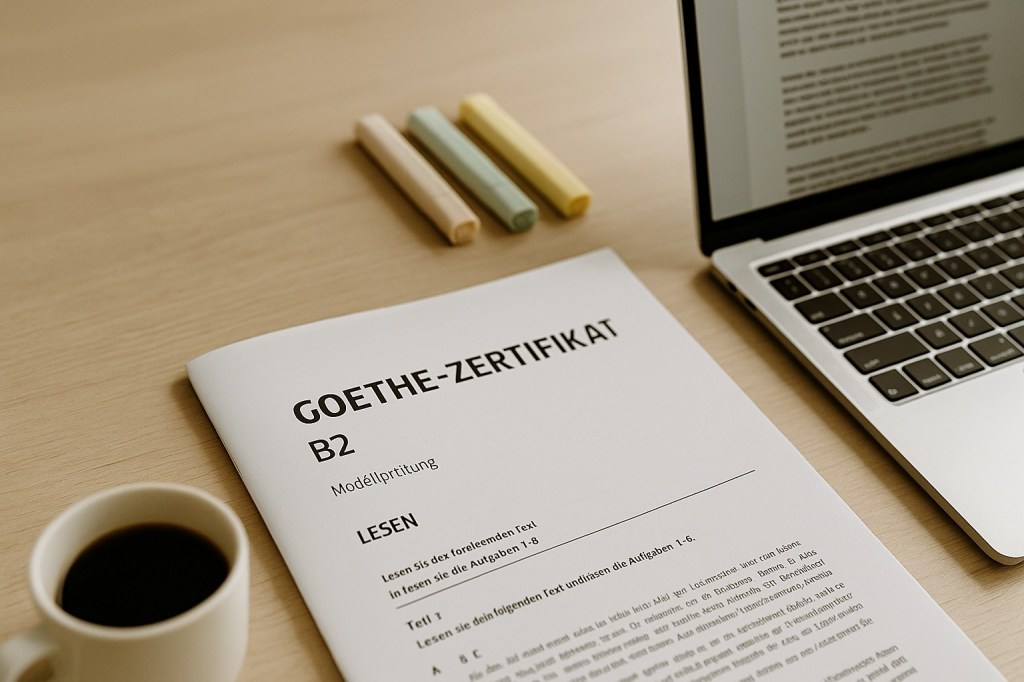
    Why I Signed Up for the Goethe B2 Exam (And How I’m Preparing)

    I finally did it — I signed up for the Goethe B2 exam and put a real date on the calendar. I’ve been learning German while working full-time, and I wanted something concrete to aim for. Over the past few months, I’ve felt myself hovering around the same level, comfortable but not improving. Setting an exam date gives me a deadline and forces me to confront weak spots I usually avoid.

    This post is about why I registered, what the certification means to me, and how I’m building a realistic plan from now until this summer.


    Why I Wanted a Base Certification

    I’ve been learning German on and off for about five years. At some point, I wanted something that reflects that effort — not to show off, but as a personal benchmark. I also like the idea of having a recognized certification in case I ever want to study or work in Germany. It’s the largest economy in Europe, and the idea of building part of my life there has always been in the back of my mind.

    B2 represents the point where the language stops being fragile. You can function professionally, watch native media without subtitles, and hold your own in fast conversations. Signing up for this exam is my way of saying: I’m committed long-term, and I want to see this through.

    And if I fail? Fine. That’s not the point. I’m not learning German to chase a perfect score. I’m learning it because I genuinely enjoy it — and because I want the momentum that a real deadline brings.

    It also pushes me out of my comfort zone. I tend to avoid speaking in front of others, and the speaking portion of the exam won’t let me hide from that. It’s uncomfortable, but necessary.


    Why Having a Goal Outside of Work Matters

    Working full-time creates a predictable routine. I like my job, and I’m grateful for it, but I also want something outside of work that challenges me — something that’s mine. Language learning fills that role. It demands consistency, effort, and patience.

    Preparing for the exam keeps me structured, motivated, and mentally sharp. It gives me healthy pressure: a real deadline, a reason to stay consistent, and a sense of purpose beyond my career.

    It’s easy to let months pass by without realizing how little progress you’ve made. This exam forces me to stay engaged.

    Having a set exam date gives my weeks more structure. Even when work gets busy, I can’t ignore German the way I sometimes might without a deadline. Studying becomes part of my day — like going to the gym or making coffee.

    It grounds me and keeps me accountable.


    Why I Chose the Goethe B2 Exam Specifically

    The Goethe-Institut is recognized around the world — by universities, employers, and immigration offices. That matters to me. If I ever end up studying or working in Germany, this is the certification they’ll recognize.

    The exam is balanced:

    • reading
    • listening
    • writing
    • and speaking

    I’m strong in reading and listening, but writing and speaking still need steady work. Goethe’s format requires improvement in the areas I tend to avoid. And B2 feels like the right challenge — ambitious but realistic with consistent effort.

    It also feels good to be evaluated academically after years of casual learning. I want to know how well I can actually use this language.


    My Timeline: From Today Until The Exam

    I have a little more than six months to prepare. That’s plenty of time, but only if I’m consistent.

    Phase Zero (Now → Early December):

    Clearing personal tasks I’ve been putting off, organizing my materials, and building a real study plan. Think of it as setting the foundation.

    Phases One, Two, and Three (Dec → Summer):

    Each phase includes weekly goals built around the four core skills: reading, listening, speaking, and writing. I’m not aiming for perfection — I’m aiming for steady exposure.

    My weekly minimum looks like this:

    • 30–45 minutes of active study per weekday
    • Daily reading or listening
    • One speaking session per week
    • One written assignment for correction
    • Monthly checkpoints to stay on track

    I want repeated contact with grammar, vocabulary, and exam-style tasks. Consistency beats intensity.


    My Game Plan: How I’m Studying

    1. Grammar

    Review all B1 foundations to close gaps, then move systematically through the main B2 structures.

    2. Vocabulary

    Use LingQ, reading, and daily immersion. No flashcard burnout — just steady exposure to real language.

    3. Listening

    Podcasts, YouTube, news, and anything I actually enjoy.

    4. Reading

    Novels, articles, blog posts, and short stories — slow but steady.

    5. Speaking

    Weekly iTalki lessons and shadowing in between to build confidence.

    6. Writing

    A weekly journal entry that I get corrected and refine over time.


    The Journey Begins Now

    Signing up for the B2 exam was the first step. Now comes the work — the daily, steady effort that builds real skill. If you’re thinking about learning a language or taking an exam, I hope this gives you a realistic picture of what this stage looks like.

    I’ll share updates as I move through each phase and get closer to the exam!

  • How I Use ChatGPT to Learn Languages: My Favorite Prompts and Strategies

    How I Use ChatGPT to Learn Languages: My Favorite Prompts and Strategies

    Introduction

    As language learners, we’re always talking about immersion — textbooks, regular books, audiobooks, podcasts, YouTube channels, courses, what have you. And now AI is quickly becoming a part of that process and conversation. It’s already showing up in our daily routines, sometimes behind the scenes and sometimes directly when we open ChatGPT to ask a question or get feedback.

    For me, ChatGPT has become part of my daily study routine. It’s like having a patient tutor who never gets tired of my grammar mistakes. I’m currently learning German, Spanish, and Hungarian — all while working full-time — so I’ve had to find ways to make my study time more efficient.

    AI gets talked about in nearly every area of life right now, and while I don’t use it for everything, it does help me streamline a lot of the smaller, repetitive tasks — like lesson planning, outline creation, and quick grammar checks.

    Here are the exact ChatGPT prompts I use every week for vocabulary, grammar, writing, and conversation practice — and how they help me study smarter, not harder.


    Why ChatGPT Works for Language Learning

    Like a lot of AI tools, ChatGPT makes language learning both more accessible and more efficient. It gives instant feedback and corrections, adapts to your level (whether you’re A1 or C2), and can mimic simple real-life conversations.

    For example, if I just finished an iTalki lesson and there was something I didn’t quite understand — maybe my tutor said a phrase I couldn’t keep up with — I’ll go to ChatGPT and recreate that conversation. I might say:

    “Pretend you’re my tutor. I’m a B1 German learner. We just talked about daily routines, but I didn’t understand part of what you said. Can you write out that dialogue again slowly and explain it in English?”

    Within seconds, I have a version I can study, highlight, or reuse.

    It’s also great for decision-making paralysis. Let’s say I want to study reflexive verbs in German but don’t know where to start. I can simply ask:

    “Give me 20 example sentences in German practicing reflexive verbs. I’m at a B1 level.”

    Or even:

    “What are the 20 most common reflexive verbs in German? Give me both the English translation and a short example sentence.”

    Done. No flipping through pages, no Googling for exercises. It’s quick, clear, and customizable.


    My Prompts for Vocabulary Building

    Decision fatigue is a real problem when learning a language. Some days, you just don’t know how to study. ChatGPT takes that off your plate by instantly generating structure.

    Here are a few of my go-to prompts:

    1. “Give me 20 words about daily routines in German with example sentences.”
    2. “Create a mini-quiz to test me on these words: [insert list].”
    3. “Write a short story using these 10 Spanish words about travel.”

    Within seconds, I have an exercise, explanation, or even a mini-lesson plan. It turns passive vocabulary lists into something active and usable.

    I’ll usually transfer new words into LingQ, a spreadsheet, or a notebook. The point isn’t just memorizing — it’s using those words in real context, and ChatGPT helps create that context instantly.


    My Prompts for Grammar Practice

    This is where I focus on precision and structure. Grammar can feel intimidating, but with AI, I can break it down into smaller steps.

    Here are two ways I use it:

    1. Quick explanations:
      “Explain the difference between war and wäre in German with examples.”
    2. Corrections and rewrites:
      “Take a look at this paragraph I wrote in Spanish and tell me what mistakes I made. Then rewrite it correctly and explain why.”

    I’ll often ask ChatGPT to first explain in English, then again in the target language so I can see both sides. That repetition helps me retain the concept better.

    These short grammar sessions make it easier to understand why something is correct, not just memorize the rule.


    My Prompts for Speaking and Writing

    Sometimes you don’t have a conversation partner available — and that’s where AI comes in handy. I use ChatGPT to simulate conversations or writing exchanges that feel surprisingly real.

    Here are a few examples:

    • “Pretend we’re friends who haven’t seen each other in a while — write me a letter and let’s be pen pals.”
    • “Act as my coworker. Let’s practice a workplace email exchange.”
    • “Ask me five follow-up questions like a native speaker would.”

    You can easily turn these into low-stakes speaking or writing exercises. I’ll sometimes read my answers aloud, record them, and then paste them back into ChatGPT for correction. It’s practice on demand — flexible, consistent, and gamified.

    It gives you control over your practice environment, allowing repetition until you feel comfortable using the language in real life.


    How to Create Your Own Prompts

    The key to using ChatGPT effectively is specificity. Be clear about your level, your goal, and what role you want it to play. When you use AI, start by answering three questions: Who am I? Who are you? What are we trying to do?

    Example:

    “Act as my A2-level Spanish tutor and quiz me on food vocabulary. I am a A2 level learner who is a native English speaker.”

    Or:

    “Pretend you’re a native Hungarian teacher helping me prepare for small talk at a café. Ask me questions and correct my mistakes. I am new to the Hungarian Language.”

    Think about your weak spots: a confusing textbook section, an iTalki conversation that tripped you up, or a phrase you’ve always avoided saying. Then build your prompts around those challenges.

    I also recommend asking ChatGPT to summarize what it thinks you’re asking before you start. I’ll say:

    “Can you explain what you think my goal is and how you’re going to help me achieve it?”

    That ensures you’re on the same page.

    Lastly, keep a running list of your favorite prompts in a Notes app or Google Doc. Over time, you’ll build your own AI-powered toolkit.


    Final Thoughts

    I think AI does a great job of making language learning more accessible, flexible, and efficient. It’s not perfect, and it definitely doesn’t replace human teachers — after all, learning a language is about connecting with other people, not just an algorithm.

    AI helps us practice, prepare, and improve — but human connection is still the heart of it.

    Maybe that’s a topic for another post.

    For now, I encourage you to try one of these prompts today — or tell us what prompts you’ve been using. How do you use AI for language learning? What are its downsides, or how could it be improved?

    Thanks for reading.

  • Title: How I Learn Languages with a 9-to-5 Job: My Daily Routine

    Title: How I Learn Languages with a 9-to-5 Job: My Daily Routine

    Making consistent progress in language learning is all about setting aside time — intentionally. For those of us working a 9-to-5, that requires some planning and commitment.

    Right now, I’m learning German while also working a full-time job. I’ve found that the key isn’t having endless hours — it’s building small habits that fit naturally into your day. Here’s how I fit meaningful language learning and daily input into my current schedule.


    Morning Routine: Coffee and Comprehensible Input

    I like to start my day with coffee — and that’s the perfect time to get some input in my target language. My mind is still waking up, which makes reading feel calm and unhurried.

    Most mornings, I’ll spend about 30 minutes reading in German. Sometimes it’s a book, sometimes an article or lesson on LingQ. I like this time because it eases me into the day while also familiarizing me with new words and phrases.

    Starting the morning in your target language sets the tone for the rest of the day. You’re already thinking in that language — and if something you read sparks your interest, you’ll carry that curiosity with you for hours.


    Commute Routine: Turning My Commute into a Classroom

    I have about a 30-minute commute, and this is when I like to shift into listening mode. Most days, I’ll put on a podcast or audiobook in German.

    Sometimes, the night before, I’ll download a YouTube video from LingQ (around 20–30 minutes long). On the way to work, I’ll listen to the audio and see how much I understand. Later that night, I’ll go back on LingQ to read through the transcript, look up new words, and reinforce what I heard.

    Even if I only catch parts of the conversation, this routine keeps the language fresh in my mind and helps build my listening comprehension naturally.


    Workday Input: Light and Sustainable

    Throughout the workday, when feasible, I like to keep light input going in the background — maybe another podcast or some music.

    During repetitive tasks, it’s easy to throw on something in the target language without losing focus. Hearing the intonation and rhythm of the language helps me when I later read or speak — my mind has already internalized how the sentences should sound.

    It’s not about studying intensely here. It’s about keeping the rhythm alive so that the language feels like part of your normal day.


    Evening Routine: Active Study Time

    After work, I usually spend 20–30 minutes actively studying — most often on LingQ, reviewing vocabulary or reading new material efficiently.

    If I still have energy, I’ll also listen to a short podcast, news clip, or even music in German on the way home. I try to make sure that, whatever I’m doing — podcasts, music, or even the news — I’m getting at least some of it in my target language.

    Not every evening looks the same, but the goal is simple: finish the day with at least one focused session that reinforces what I’ve seen and heard earlier.


    Nighttime Wind-Down: Reading Before Bed

    Before bed, I like to put my phone down and pick up a book. I used to listen to audiobooks in German as I fell asleep, but now that my comprehension is higher, I end up staying awake because I’m too focused on the story!

    So instead, I read a German book for about 10–15 minutes. It’s enough to wind down while still getting exposure to new words and sentence patterns. Most nights, that’s all it takes before I’m ready to sleep — and I like to think my brain keeps processing the language overnight.


    Weekend Routine: Deep Dives and Output

    My weekend routine looks similar, just more flexible. This is when I like to go deeper — watching longer videos, exploring travel vlogs in German, or uploading new content to LingQ for the coming week.

    I also spend time on grammar or output — writing short journal entries, reading out loud, or scheduling iTalki lessons to get real speaking practice.

    Reading aloud helps me get used to how I sound in the language. It makes actual conversations less intimidating because the words already feel natural coming out of my mouth. Grammar might not be the most exciting part, but I’m starting to appreciate how essential it is for real progress.


    Small Steps, Big Progress

    If I had to sum up my approach, it’s this:
    Whenever I’d normally be scrolling my phone or listening to something in English, I try to do it in my target language instead.

    If I’m listening to music, I’ll play Die Toten Hosen instead of my usual playlist. If I want a podcast or audiobook, I’ll find one in German. That way, I’m not creating extra study time — I’m just living my normal life through another language.

    That’s how progress adds up — small, steady habits layered into everyday routines.

    What Is Your Routine?

    How do you balance language learning with your job or studies?
    Drop a comment below and share your routine — I’d love to hear what works for you.

  • Learning Languages with LingQ: My Update

    Learning Languages with LingQ: My Update

    It’s been a while since I’ve written here, so I wanted to give a quick update on what I’ve been doing with language learning. My idea for this blog has always been to track my progress and maybe build a system that I and other learners could reuse. Nothing fancy — just something consistent.

    Lately, I’ve been using LingQ a lot, and it’s become my main tool for both German and Spanish. What I like about it is how simple it is: you just read or listen to stuff in your target language, and the app helps you track words you know, words you’re learning, and words you don’t know yet. Over time, it shows you stats on how much you’ve read, how many new words you’ve added, and how your vocabulary is growing. That kind of feedback makes it easier to see that I’m making progress.

    How I Use LingQ

    If I want to focus on grammar, I can go through short lessons. If I want real content, I can pull in YouTube transcripts or even Netflix shows. It’s flexible, which makes it more interesting than sticking to just a textbook or one app’s lessons.

    The best part is how it handles unknown words. Normally, if I’m reading and don’t know a quarter of the words, I’d just get frustrated. I might guess the general meaning, but it’s easy to lose motivation if I have to keep stopping to look things up. With LingQ, I can click on a word, see the meaning, and keep going. That keeps the flow going and makes reading feel more doable.

    My Current Routine

    Here’s what my routine looks like right now:

    • About 30 minutes of reading on LingQ, sometimes silently, sometimes out loud.
    • Around 20–30 minutes of listening, either with the text open or in the background while I’m doing something else.
    • One 30-minute speaking session a week in German with a tutor.

    Most of my focus is on German, but I’m keeping Spanish in the mix too. The speaking part is the hardest for me — it’s the part I’ve always been most nervous about — but I can feel myself getting a little more confident each week. Reading and listening help build the base, but speaking forces me to actually use what I know.

    What’s Working

    The mix of reading, listening, and speaking feels balanced. When I watch shows or listen to podcasts now, I sometimes notice words I just saw on LingQ. That tells me it’s working. It’s a slow process, but the connections are starting to click.

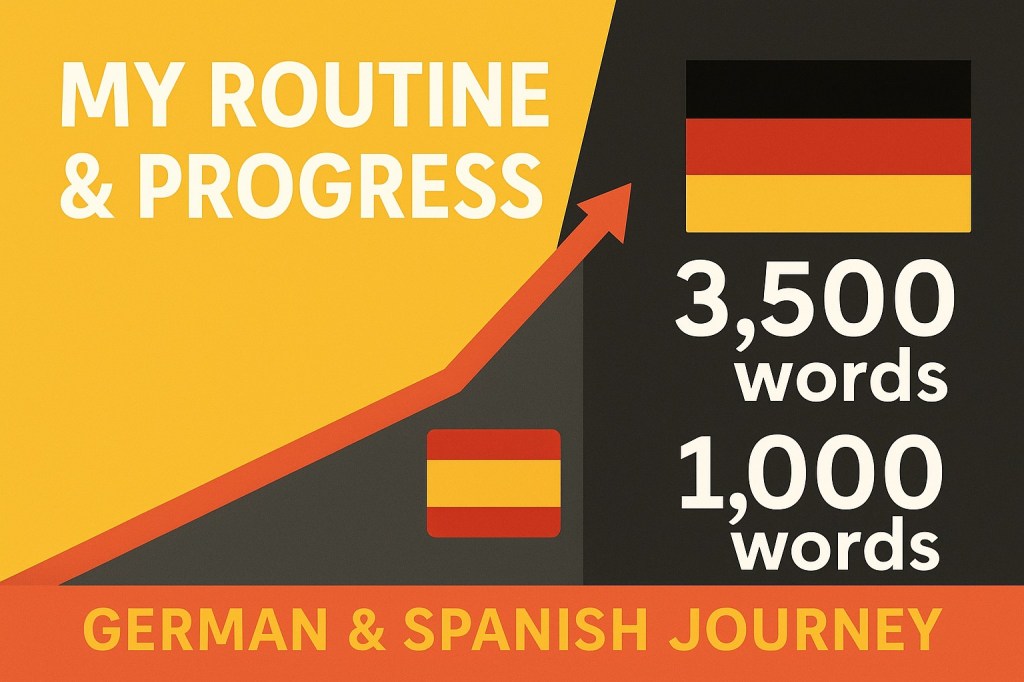
    I also like that LingQ isn’t gamified. There are streaks and coins you earn, but it doesn’t feel like the main part of the app. I couldn’t tell you my current streak or amount of coins I have. However, it does track the words you know and I’m hovering around 3,100 for german. If we’re going to track stats, that’s one that I care more about.

    What’s Next

    My plan is to keep this routine going daily — or as close to daily as possible. Even 20–30 minutes is enough to feel like I’m moving forward. Next, I want to experiment more with importing my own content, especially Netflix shows and YouTube videos, so that I’m learning from things I’d actually be watching anyway.

    I’ll also keep writing here with updates every week or two. My goal is to make these posts straightforward progress logs that others could copy and use for their own studies.

    Wrapping Up

    So that’s where I’m at: a simple routine, mostly built around LingQ, with some speaking practice mixed in. It’s not perfect, but it’s consistent, and that’s what matters. I’ll share more soon about how I combine LingQ with Netflix to make study sessions more immersive.

    Until then, I’ll keep reading, listening, and speaking whenever I can.

  • The Tools, Tech, and Tactics I Use to Learn Languages

    Hello!

    My name is Joe, and I’m on a journey to become fluent in both German and Spanish. I’ve been studying German on and off for several years, but recently, I’ve committed to taking it more seriously—while also beginning the exciting adventure of learning Spanish from scratch.

    In this post, I want to share the physical tools, software, and apps that have helped me along the way—and which ones I reach for depending on the task. Everyone learns differently, but I hope this gives you some helpful ideas to use in your own language learning journey.

    1. Notebook and Pen: The Writing Classics

    When I first started learning German in college, I bought a basic spiral notebook and grabbed a pen. Simple—but not ideal. The ink often bled through, and the pages wore out fast.

    Recently, I upgraded to a Paperpage hardcover notebook. It’s slightly more expensive, but the thicker pages and sturdy cover make a big difference. Since I write a lot in the target language, having a durable notebook feels like a small investment in long-term success. It also creates a sense of commitment—I’m not just dabbling anymore.

    Also: get a pen you like. Seriously. Writing with a pen you enjoy makes everything smoother. I currently use the Sharpie S-Gel 0.7mm, which is affordable and glides nicely.

    2. YouTube & Spotify: Learn from Real Speakers

    YouTube and Spotify have been indispensable tools for learning. The Easy Languages YouTube channel is one of my favorites for real conversations with subtitles. I also enjoy channels like @BulgarianPod101, especially their playlist of 300 essential phrases—I’m learning these to be a more polite and prepared guest when I visit Bulgaria later this year.

    On Spotify, I follow podcasts in my target language. It’s a great way to practice active listening, even while doing chores or going for a walk. Hearing natural prosody—the rhythm and melody of the language—has helped me improve my comprehension immensely.

    3. Apps: Great for Starting, Not for Everything

    Like many, I’ve chased the thrill of keeping my Duolingo streak alive, even with just a few minutes before midnight. I actually still have a yearly family membership—thanks to forgetting to cancel the free trial (despite the reminders from Duolingo). But having unlimited hearts makes it less stressful, especially when exploring a new language.

    Duolingo plays like a game and is fantastic for beginners, but I don’t rely on it alone. It’s great for exposure, but not as effective for writing or speaking. Pair it with real conversation practice, writing exercises, or grammar explanations.

    Key Strengths: Grammar drills, beginner-friendly, has a free version.

    I’ve also used Rosetta Stone, especially before trips to Germany and Portugal. It helped me memorize useful phrases through visual association, and I recently started their Turkish course (1 lesson a day!) in preparation for an upcoming trip.

    Key Strengths: Phrase memorization, strong emphasis on speaking, image-word pairing.

    4. ChatGPT: My Language Learning Assistant

    If the internet made self-study accessible, ChatGPT made it efficient. I use it for everything from generating vocab lists and grammar explanations to practicing dialogue and writing emails in my target language.

    Want 50 travel-related words? Need help with the dative case in German? Or a short dialogue for checking into a hotel? ChatGPT has your back.

    That said, AI can’t replace real human interaction. To build confidence, you still need to talk with real people. Nothing replaces the value of conversation, even if it’s awkward at first.

    Strengths: Organization, explanations, conversation prompts, flexibility.

    Final Thoughts

    At the end of the day, your tools are just that—tools. What matters most is how often and how creatively you use them. Whether you prefer physical notebooks, immersive podcasts, language apps, or AI helpers, choose the mix that helps you stay consistent and curious.

    What are your favorite tools? Let me know in the comments—I’m always looking to try something new!