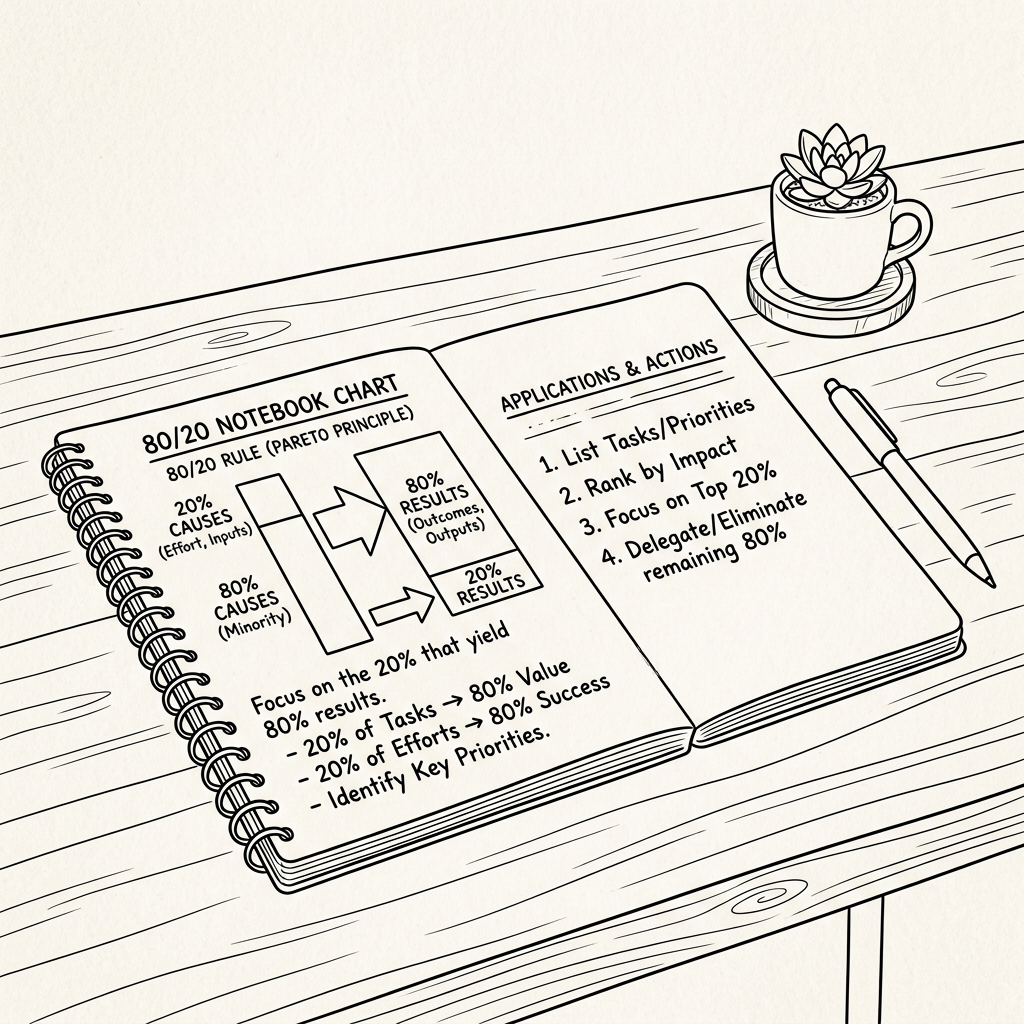
If you’re into learning—especially languages or efficiency—you’ve probably heard of Pareto’s Law.
I’m not an expert, and I’m not claiming to be, but the basic idea is simple:
80% of your results come from 20% of your actions.
You see this everywhere:
- 80% of wealth is held by 20% of people
- 80% of outcomes come from a small portion of effort
The idea is that results are concentrated. Not all effort is equal.
So I’ve been thinking about this as I prepare for my German B2 exam at the Goethe-Institut this June.
What I Actually Need to Pass
I don’t need a perfect score.
The exam has four parts:
- Listening
- Reading
- Writing
- Speaking
To pass, I need about 60% in each section. That’s it.
So the question becomes:
What’s the 20% of effort that will get me there in the next month?
Listening and Reading (Already Covered… I Think)
The first two sections are:
- Listening (audio + multiple choice)
- Reading (texts + multiple choice)
If you’ve taken tests before, multiple choice usually feels a bit easier—and I feel okay about these.
I already:
- Listen to audiobooks, podcasts, YouTube in German
- Read daily
- Have a decent vocabulary base
These sections are about input, not output.
It’s: Can I understand what’s being said? Can I follow along?
I think I can hit 60% here fairly comfortably. At least, that’s the plan.
So What Do I Actually Need to Work On?
With about a month left, I can’t improve everything.
This is where Pareto’s Law comes in.
Instead of trying to level up every area equally, I’m focusing on the things I know I’m weak at—the things that will actually move the needle.
For me, that comes down to two main areas:
- Speaking
- Writing
Speaking: Pure Repetition and Exposure
One part of the test is speaking with a partner.
From what I understand, you might:
- Have a conversation about a topic
- Share your opinions
- Possibly plan something together (like a trip or itinerary)
I haven’t taken the test yet, so this is based on what I’ve read and seen.
My plan is simple:
- 3 speaking lessons per week
- 45–60 minutes each
- With a native speaker (on italki)
This isn’t about being perfect.
It’s about:
- Keeping the conversation going
- Understanding questions
- Responding naturally, even if it’s not flawless
Over the next few weeks, I want to get ~15 hours of real conversation.
It’s basically exposure therapy.
The pressure forces effort.
And the repetition builds confidence.
Writing: Structure Over Perfection
The last part is writing, and from what I’ve seen, it’s not overly complex—but it is structured.
You’ll likely need to:
- Write a short essay (a few hundred words)
- Respond to a topic (for example: social media use)
- Present pros and cons
- Share your opinion
This isn’t just about vocabulary or grammar.
It’s about:
- Knowing how to structure an argument
- Introducing a topic
- Giving both sides
- Stating your opinion clearly
So my focus is:
- Daily short writing practice
- Practicing essay structure
- Learning key phrases in German for arguments and transitions
The Other Writing Task: Emails
There’s also an email-writing section.
Again, this comes down to structure:
- Opening
- Purpose
- Body
- Closing
So I’m practicing:
- Writing simple emails
- Learning standard phrases
- Getting comfortable with format
My 80/20 Plan (Simplified)
I don’t know for a fact that this is the perfect strategy.
But these are the things I know I don’t know yet, and I think they’ll have the biggest impact.
So I’m simplifying everything down to this:
- 3 speaking lessons per week
- Daily writing practice (essays + emails)
- Focus on structure, not perfection
That’s it.
Final Thought
This isn’t about mastering German in a month.
It’s about doing the right things to pass the test.
Pareto’s Law might not be exact—but it’s a useful way to think:
Focus on the small number of actions that actually move the needle.
Right now, for me, that’s speaking and writing.
We’ll see if it works.