Tag: german

  • Introducing the Next Adventure Reader

    Introducing the Next Adventure Reader

    Turn Any Topic Into a Language Learning Adventure

    One of the biggest challenges in language learning isn’t motivation. It isn’t grammar. It isn’t even vocabulary.

    It’s figuring out what to do when you sit down to study.

    As language learners, we often spend more time searching for content than actually learning. We open YouTube looking for a video. We search for an article to read. We look through podcasts, textbooks, flashcards, and apps trying to decide what to study.

    By the time we’ve made a decision, half of our study session is gone.

    That’s the problem I wanted to solve when I created the Next Adventure Reader.

    Why I Built the Reader

    Over the last few years, I’ve spent hundreds of hours learning German, Spanish, and Portuguese. Like many language learners, I discovered that one of the most effective ways to improve is through reading and comprehensible input.

    The challenge is finding enough content.

    Sometimes native material is too difficult. Sometimes learner material is too boring. And sometimes you just want to read about something that genuinely interests you.

    Maybe you want to read about Ancient Rome.

    Maybe you’re interested in Viking history.

    Maybe you’d rather learn about space exploration, philosophy, travel, economics, or the history of Brazil.

    The Next Adventure Reader allows you to generate reading material based on topics you actually care about while practicing the language you’re learning.

    What Is the Next Adventure Reader?

    The Next Adventure Reader is a language-learning tool that generates custom articles and reading adventures in your target language.

    Simply choose:

    • Your target language
    • A topic that interests you
    • Your preferred difficulty level

    The Reader then creates a unique article designed to help you spend more time interacting with the language and less time searching for content.

    Whether you’re learning German, Spanish, Portuguese, or another language, the goal is simple:

    Read more. Learn more. Explore more.

    More Than an Article Generator

    The Reader isn’t just about creating reading material.

    It’s about creating an entire study session in seconds.

    Many learners know they should read, review vocabulary, practice speaking, and test comprehension. The problem is organizing all of those activities.

    The Reader helps create a simple structure that can be repeated every day.

    Step 1: Read the Article

    Choose a topic and begin reading.

    Focus on understanding the overall meaning rather than translating every word.

    Step 2: Read Aloud

    After reading silently, read the article aloud.

    Reading aloud helps reinforce pronunciation, improve speaking confidence, and develop reading fluency.

    Step 3: Review Vocabulary

    Identify new words and phrases from the article.

    Because the vocabulary appears in context, it becomes easier to understand and remember than isolated vocabulary lists.

    Step 4: Answer Questions

    Test your comprehension by answering questions related to the article.

    This encourages active engagement and helps ensure that you’re understanding what you’ve read.

    Step 5: Write a Response

    Optionally, write a short summary or answer an open-ended question about the topic.

    This gives you an opportunity to produce the language yourself and reinforce what you’ve learned.

    In less than 30 minutes, you’ve practiced reading, speaking, vocabulary acquisition, comprehension, and writing.

    All from a single article.

    Who Is This Tool For?

    The Next Adventure Reader is designed for:

    • Language learners who want more reading practice
    • Intermediate learners trying to build vocabulary
    • Travelers preparing for international trips
    • Students looking for comprehensible input
    • Anyone who wants a simple daily language-learning routine

    If you’ve ever sat down to study and thought, “What should I do today?” this tool was built for you.

    The Goal of Next Adventure Languages

    I’ve always believed that language learning should feel like an adventure rather than a chore.

    Languages open doors to new countries, cultures, friendships, careers, and experiences. The more time we spend interacting with the language, the more progress we make.

    The Next Adventure Reader was built to make that process easier.

    Instead of spending your study session searching for content, you can spend it reading, speaking, learning vocabulary, and exploring topics that genuinely interest you.

    Because the best language-learning resource is the one you’ll actually use.

    Try the Next Adventure Reader

    Ready to create your next language-learning adventure?

    Give the Reader a try, generate an article on a topic you love, and see how quickly you can build a complete study session around it.

    Your next adventure starts with a single article.
  • How I Passed the Goethe B2 German Exam Using Mostly Comprehensible Input

    How I Passed the Goethe B2 German Exam Using Mostly Comprehensible Input

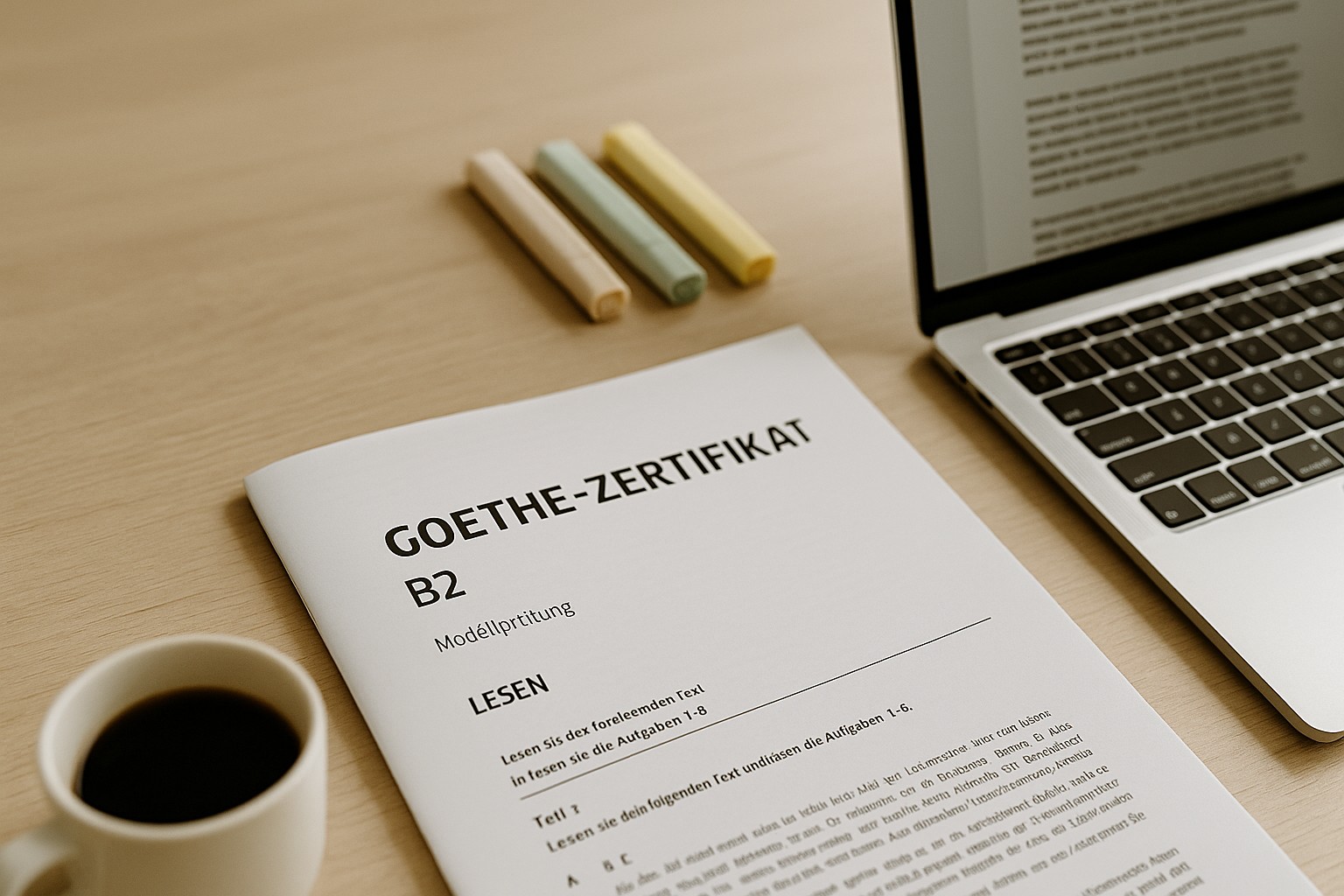
    I recently passed the Goethe B2 German exam in Chicago.

    For a lot of language learners, the B2 level is an important milestone. It’s often considered the point where you can comfortably function in the language, hold conversations, consume native content, and begin using the language in real-world situations.

    So how did I get there?

    Let’s look back at the journey.

    Where I Started

    About a year ago, I made the decision that I wanted to take my German seriously.

    At the time, I was probably somewhere between an A2 and B1 level. I could understand some German, read simple texts, and hold basic conversations, but I certainly didn’t feel confident saying that I could actually speak the language.

    Like many language learners, I didn’t really have a clear plan.

    I was using Duolingo here and there. I was reading some German language-learning books. I was studying a little grammar. But nothing felt particularly effective or sustainable.

    Then I discovered LingQ.

    The Tool That Changed Everything

    LingQ became my primary learning platform.

    Now, before going any further, I want to make something clear: I do not consider myself fluent in German.

    I passed the B2 exam, but I’m still learning every day. I still make mistakes. I still struggle with grammar, cases, and word order.

    However, LingQ introduced me to the concept of comprehensible input, and that completely changed my approach to language learning.

    Every day I would read. My goal was at least 1,000 words of reading each day which the app would keep track for me.

    Sometimes I would listen to podcasts. Sometimes I would watch videos. But the majority of my time was spent reading because I felt that reading was the fastest way for me to build vocabulary.

    When I first started using LingQ consistently, I had roughly 1,500 known words.

    By the time I took the B2 exam, that number had grown to around 8,000 known words.

    I wasn’t memorizing vocabulary lists.

    I wasn’t drilling flashcards for hours.

    I was simply reading content that interested me and gradually increasing the difficulty over time.

    Day after day.

    Month after month.

    The words started sticking naturally.

    The Speaking Problem

    About six months before the exam, I realized something important.

    My reading ability was improving significantly, but my speaking ability wasn’t keeping pace.

    I could understand far more German than I could actually produce.

    So I started working with language tutors and conversation partners on italki.

    Leading up to the exam, I averaged about 2-3 lessons per month and completed roughly 14–16 lessons in total.

    That may not sound like much, but it was enough to get regular speaking practice and become more comfortable expressing myself.

    The biggest breakthrough, however, came from something surprisingly simple.

    Reading Out Loud

    I started reading everything out loud.

    This was a game changer.

    At first, I was slow and awkward.

    But over time, I became faster and more natural.

    I got used to hearing myself speak German.

    I got used to producing German sounds.

    I got used to forming German sentences.

    Things that once felt difficult slowly became muscle memory.

    Simple phrases like:

    • Es weiß ich nicht.
    • Hallo, mein Name ist Joe.
    • Ich komme aus den USA.
    • Heute ist ein guter Tag.
    • Das Wetter ist gut.

    These kinds of phrases became automatic.

    The more I read aloud, the less intimidating speaking became.

    I wasn’t just learning German anymore.

    I was actively using German.

    What About Grammar?

    This is probably the part that surprises people.

    I didn’t spend very much time studying grammar.

    Now, that’s not because grammar isn’t important.

    I had already taken German courses in college, so I had a foundation. I understood many of the basic concepts already.

    I did review grammar occasionally.

    I probably completed around ten dedicated grammar study sessions, maybe thirty minutes each.

    That’s it.

    Most of my improvement came from exposure.

    Seeing the same structures over and over again.

    Reading thousands of sentences.

    Listening to native speakers.

    Practicing speaking.

    Over time, patterns started to feel natural.

    That doesn’t mean I mastered grammar.

    Far from it.

    I still struggle with German word order.

    I still make mistakes with cases.

    And let’s be honest: German has four cases and three grammatical genders. Those challenges don’t magically disappear.

    But I reached a point where I could communicate effectively despite those imperfections.

    And for the Goethe B2 exam, that was enough.

    Final Thoughts

    If there’s one lesson I learned from this journey, it’s that consistency beats intensity.

    I didn’t study eight hours every day.

    I didn’t memorize giant grammar charts.

    I didn’t have some secret method.

    Instead, I spent a year reading, listening, speaking occasionally, and slowly increasing my exposure to German.

    Most importantly, I kept showing up.

    Day after day.

    And eventually, those small efforts added up to a passing score on the Goethe B2 exam.

    In the next post, I’ll break down my actual exam scores, which sections surprised me, and what I would do differently if I had to prepare for the B2 exam again.

  • Apps I Actually Use for Language Learning (And Why)

    Apps I Actually Use for Language Learning (And Why)

    Over the years, I’ve tried a lot of language-learning tools. Some stuck, some didn’t. Below are the apps I actually use, what role they play in my routine, and who I think they’re best for.

    This isn’t a “top 10” list. These are tools I return to because they serve different purposes at different stages of learning.


    Duolingo

    Duolingo is marketed as a gamified, beginner-friendly language-learning app, and that’s exactly where it works best. It currently offers 40+ languages, ranging from major world languages to smaller or constructed ones, and it’s especially well known for being accessible and easy to start.

    I think Duolingo is a great way to start learning a language.

    Right now, I’m casually learning Hungarian, and I’ve found Duolingo to be a very low-impact way to gain exposure—recognizing words, patterns, and how the language sounds. It’s not intense, and that’s actually its strength. I can open it for a few minutes and still feel like I’m making contact with the language.

    Where I think Duolingo really shines is early exposure and alphabet learning. I’d like to start using it specifically to learn a new writing system—possibly Ukrainian, Korean, or even Hindi. For that initial “what am I even looking at?” phase, Duolingo does a good job of lowering the barrier.

    It’s entertaining, light, and easy to return to—which matters more than people like to admit.


    Rosetta Stone

    Rosetta Stone markets itself around immersive learning through images, audio, and repetition, avoiding translation as much as possible. It currently offers 20+ languages, with a strong focus on major global languages.

    Rosetta Stone is a great bang-for-your-buck option.

    I was gifted a lifetime membership about five years ago, and at the time, I remember it being relatively affordable compared to long-term subscriptions. Even today, it’s often priced competitively for what you get, especially if you catch a sale—especially compared to paying monthly for multiple years elsewhere.

    I used Rosetta Stone when I was a very new German learner—around A1/A2—and it helped me get comfortable with basic phrases and sentence structures. The platform relies heavily on imagery and spoken phrases, which helps concepts sink in naturally without overthinking grammar.

    Where Duolingo feels entertaining, Rosetta Stone feels calm and relaxing. It’s slower, more deliberate, and good for building familiarity rather than speed.

    I don’t use it as much now, but early on, it played a real role in making German feel less foreign. I definitely plan on returning to this app.

    LingQ

    LingQ is marketed as an input-first language learning platform, designed around reading and listening to real content rather than completing structured lessons. It supports 40+ languages, and its strength lies in flexibility rather than guided curricula.

    LingQ is my main app—and the one I use most consistently.

    You can upload almost anything: TV show transcripts, YouTube videos, articles, even text generated by ChatGPT. You can also read content uploaded by other users. It’s very much a community of language learners and teachers, but everyone is both a contributor and a learner.

    What makes LingQ powerful is how it tracks vocabulary. Every word you encounter is marked on a scale from 1 to 4, depending on how well you know it. Over time, you can literally see your understanding grow—and as your vocabulary improves, your reading speed improves with it.

    With a tap, you can see a word’s definition, pronunciation, or the full sentence it appears in. That immediacy keeps you in the flow of reading instead of breaking immersion.

    If I had to describe LingQ in one word, it would be efficient. It’s been one of the biggest contributors to my vocabulary across foreign languages.

    Explore LingQ here

    italki

    italki positions itself as a language tutoring marketplace, connecting learners with professional teachers and community tutors across 150+ languages. Unlike apps, it focuses entirely on live, one-on-one human interaction.

    This is where everything comes together.

    italki is where I take what I know and practice speaking with a real person, live and in real time. There’s pressure—and that’s the point. To keep the conversation going, I have to speak. I have to say something, even if it’s imperfect.

    Every teacher I’ve worked with has been kind, patient, and genuinely helpful. That environment has helped me get over most of my remaining fear around speaking.

    Exposure therapy works here. The more you do it, the less intimidating it becomes.

    No app replaces this. It’s where passive knowledge turns into usable language.

  • Why I Signed Up for the Goethe B2 Exam (And How I’m Preparing)

    Why I Signed Up for the Goethe B2 Exam (And How I’m Preparing)

    I finally did it — I signed up for the Goethe B2 exam and put a real date on the calendar. I’ve been learning German while working full-time, and I wanted something concrete to aim for. Over the past few months, I’ve felt myself hovering around the same level, comfortable but not improving. Setting an exam date gives me a deadline and forces me to confront weak spots I usually avoid.

    This post is about why I registered, what the certification means to me, and how I’m building a realistic plan from now until this summer.


    Why I Wanted a Base Certification

    I’ve been learning German on and off for about five years. At some point, I wanted something that reflects that effort — not to show off, but as a personal benchmark. I also like the idea of having a recognized certification in case I ever want to study or work in Germany. It’s the largest economy in Europe, and the idea of building part of my life there has always been in the back of my mind.

    B2 represents the point where the language stops being fragile. You can function professionally, watch native media without subtitles, and hold your own in fast conversations. Signing up for this exam is my way of saying: I’m committed long-term, and I want to see this through.

    And if I fail? Fine. That’s not the point. I’m not learning German to chase a perfect score. I’m learning it because I genuinely enjoy it — and because I want the momentum that a real deadline brings.

    It also pushes me out of my comfort zone. I tend to avoid speaking in front of others, and the speaking portion of the exam won’t let me hide from that. It’s uncomfortable, but necessary.


    Why Having a Goal Outside of Work Matters

    Working full-time creates a predictable routine. I like my job, and I’m grateful for it, but I also want something outside of work that challenges me — something that’s mine. Language learning fills that role. It demands consistency, effort, and patience.

    Preparing for the exam keeps me structured, motivated, and mentally sharp. It gives me healthy pressure: a real deadline, a reason to stay consistent, and a sense of purpose beyond my career.

    It’s easy to let months pass by without realizing how little progress you’ve made. This exam forces me to stay engaged.

    Having a set exam date gives my weeks more structure. Even when work gets busy, I can’t ignore German the way I sometimes might without a deadline. Studying becomes part of my day — like going to the gym or making coffee.

    It grounds me and keeps me accountable.


    Why I Chose the Goethe B2 Exam Specifically

    The Goethe-Institut is recognized around the world — by universities, employers, and immigration offices. That matters to me. If I ever end up studying or working in Germany, this is the certification they’ll recognize.

    The exam is balanced:

    • reading
    • listening
    • writing
    • and speaking

    I’m strong in reading and listening, but writing and speaking still need steady work. Goethe’s format requires improvement in the areas I tend to avoid. And B2 feels like the right challenge — ambitious but realistic with consistent effort.

    It also feels good to be evaluated academically after years of casual learning. I want to know how well I can actually use this language.


    My Timeline: From Today Until The Exam

    I have a little more than six months to prepare. That’s plenty of time, but only if I’m consistent.

    Phase Zero (Now → Early December):

    Clearing personal tasks I’ve been putting off, organizing my materials, and building a real study plan. Think of it as setting the foundation.

    Phases One, Two, and Three (Dec → Summer):

    Each phase includes weekly goals built around the four core skills: reading, listening, speaking, and writing. I’m not aiming for perfection — I’m aiming for steady exposure.

    My weekly minimum looks like this:

    • 30–45 minutes of active study per weekday
    • Daily reading or listening
    • One speaking session per week
    • One written assignment for correction
    • Monthly checkpoints to stay on track

    I want repeated contact with grammar, vocabulary, and exam-style tasks. Consistency beats intensity.


    My Game Plan: How I’m Studying

    1. Grammar

    Review all B1 foundations to close gaps, then move systematically through the main B2 structures.

    2. Vocabulary

    Use LingQ, reading, and daily immersion. No flashcard burnout — just steady exposure to real language.

    3. Listening

    Podcasts, YouTube, news, and anything I actually enjoy.

    4. Reading

    Novels, articles, blog posts, and short stories — slow but steady.

    5. Speaking

    Weekly iTalki lessons and shadowing in between to build confidence.

    6. Writing

    A weekly journal entry that I get corrected and refine over time.


    The Journey Begins Now

    Signing up for the B2 exam was the first step. Now comes the work — the daily, steady effort that builds real skill. If you’re thinking about learning a language or taking an exam, I hope this gives you a realistic picture of what this stage looks like.

    I’ll share updates as I move through each phase and get closer to the exam!